
News23. Nov. 20264 min
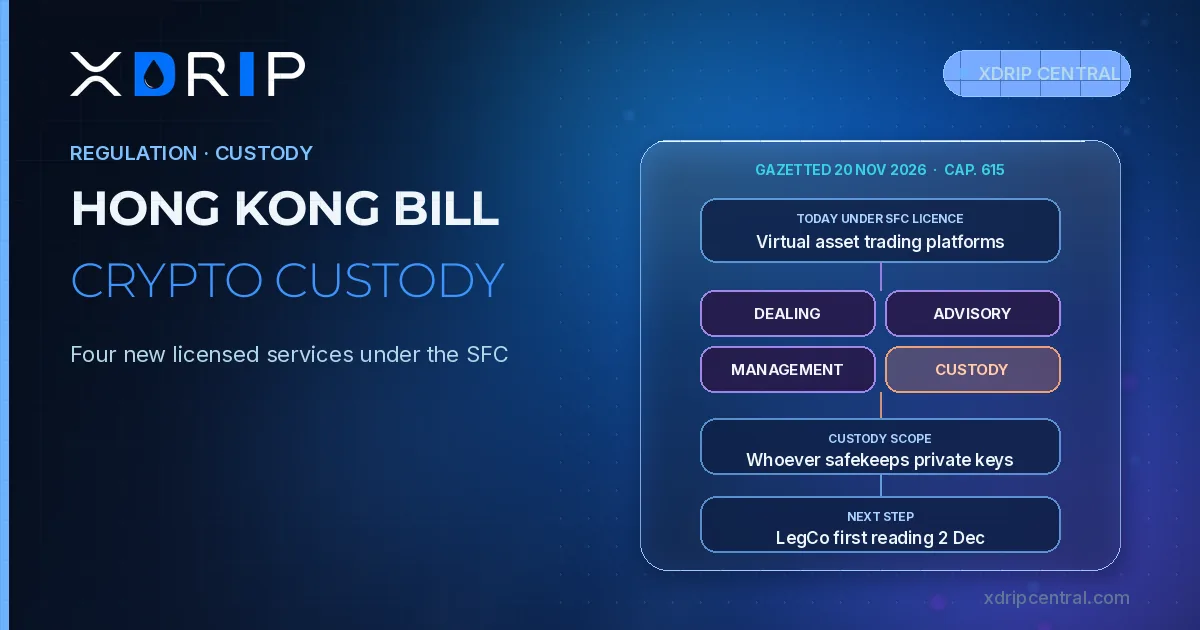
Hong Kong Bill Brings Crypto Custodians Under the SFC
Hong Kong's new bill would require crypto dealers, advisers, managers and key-holding custodians to be SFC licensed. What is known, what is still open.
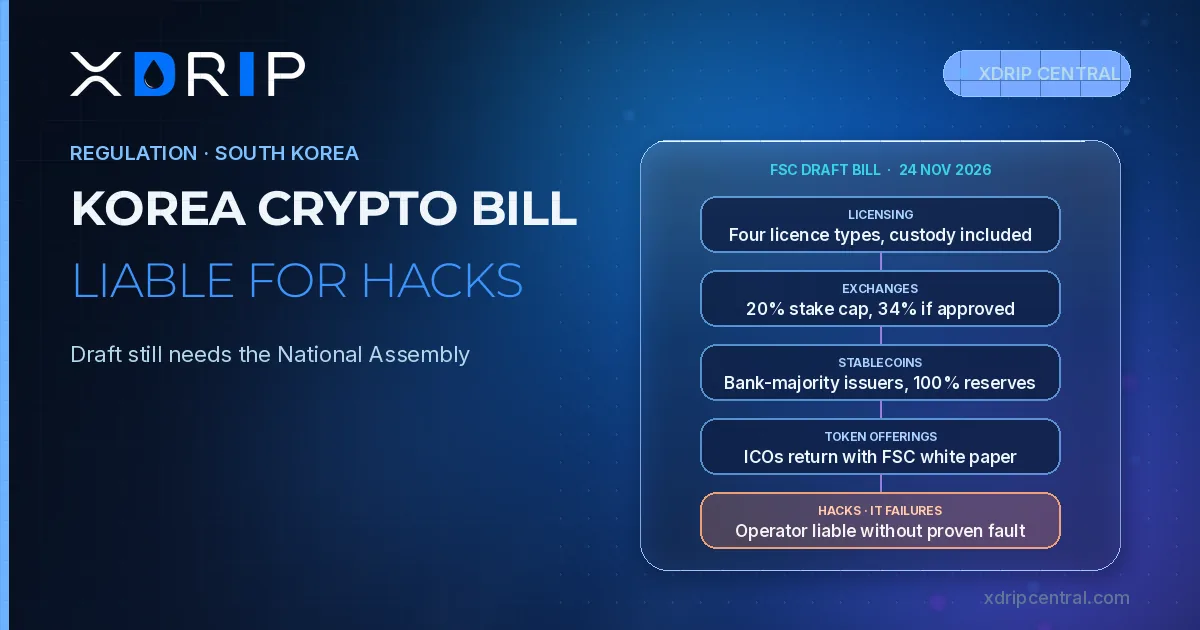
On 24 November, South Korea's Financial Services Commission (FSC) presented the government's draft of a new framework for digital assets at a Virtual Asset Committee meeting. The bill, translated by The Block as the "Act on the Innovation of the Digital Asset Industry and Protection of Users", would sit on top of the 2024 user protection law. It covers licensing, stablecoins, token offerings and who pays when a platform is hacked.
Four licence types. Service providers would be split by function: trading, brokerage, custody and storage, and investment management. Custody explicitly includes holding users' private keys and offering staking. The first three need a licence with minimum equity capital of KRW 2 billion (KRW 1 billion for stablecoin-only firms); investment managers only register, with KRW 500 million. Exact amounts are left to presidential decree.
Exchanges as infrastructure. An exchange, called a "digital asset platform service provider", would need all three core licences. Any single shareholder would be capped at 20%, or up to 34% with FSC approval, and voting rights above the cap would be suspended. Existing operators get three years to comply, with up to three more for smaller exchanges.
Stablecoins. Won-pegged "digital payment tokens" would need an FSC licence, KRW 5 billion in equity capital, 100% reserves held at an institution such as a bank, redemption at par on request and no interest to holders. Initially only consortiums in which banks hold more than 50% could issue, although a fintech firm could be the largest single shareholder. Reserves would be shielded from seizure, and the reserve manager could pay holders directly if an issuer fails or cannot operate after a hack. Foreign issuers would need home-country supervision, a local office and FSC registration. Tokens without approval could not be listed, traded or held in custody.
Token offerings. The ICO ban in place since 2017 would end for offerings with an FSC-accepted white paper and a cooling-off period. Exchanges would file a listing report before listing an asset, including assets already trading, and disclose hacks or supply changes immediately. False or missing material information would bring strict liability for the filer and its executives.
Operators would have to meet financial-company standards for security staff, IT systems, authentication and contingency planning. They would keep user assets segregated and insulated from setoff or seizure, with periodic external audits. If users lose funds through a hack or IT failure, the operator would in principle be liable without fault being proven. According to the FSC's Korean summary, users carry part of the responsibility only in cases of their own intent or gross negligence, or where the terms of service provide for it. Where an incident follows a breach of the security duties, the FSC could impose a surcharge of up to 10% of revenue.
For custody design, this moves the risk of key compromise onto the balance sheet of whoever holds the keys. That is a stronger incentive than a fine for keeping signing material segmented and limiting what hot systems can move.
The draft brings Korea closer to the activity-based licensing seen in MiCA and Hong Kong. Its most concrete technical consequence is the liability rule: an exchange or custodian would answer for a breach even if it did everything it was required to do. We will follow the National Assembly debate, especially how "hack" and "IT failure" are defined, before drawing firmer conclusions.
News23. Nov. 20264 min
Hong Kong's new bill would require crypto dealers, advisers, managers and key-holding custodians to be SFC licensed. What is known, what is still open.
News16. Nov. 20264 min
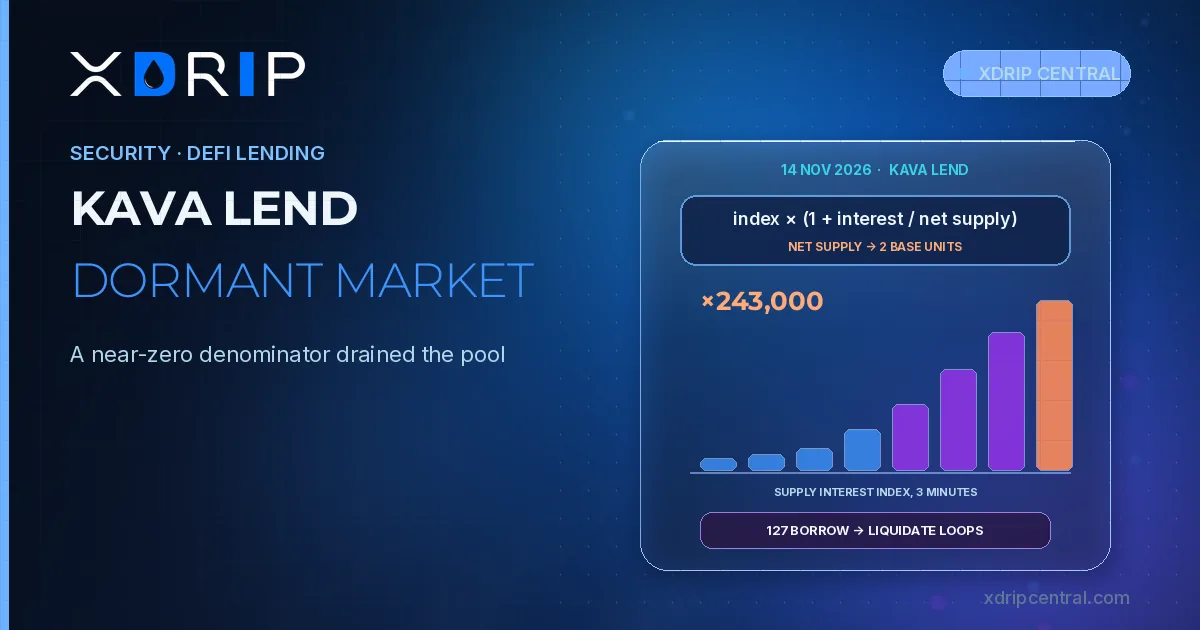
An interest-index flaw in Kava Lend's near-empty BUSD market let an attacker borrow about 55M KAVA. What the code did, what is known and what is not.
News13. Nov. 20264 min
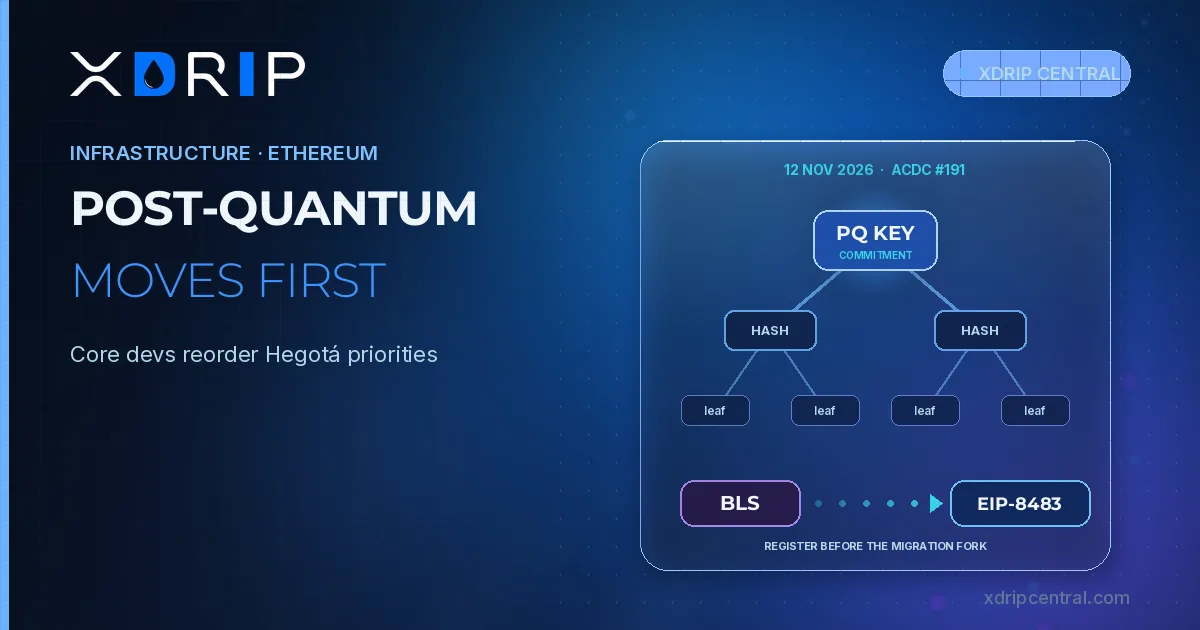
At ACDC #191 Ethereum devs withdrew Quick Slots and moved EIP-8483 post-quantum key registration toward Hegotá. What it does and what is still undecided.