
NewsNov 13, 20264 min
Ethereum Core Devs Put Post-Quantum Work First
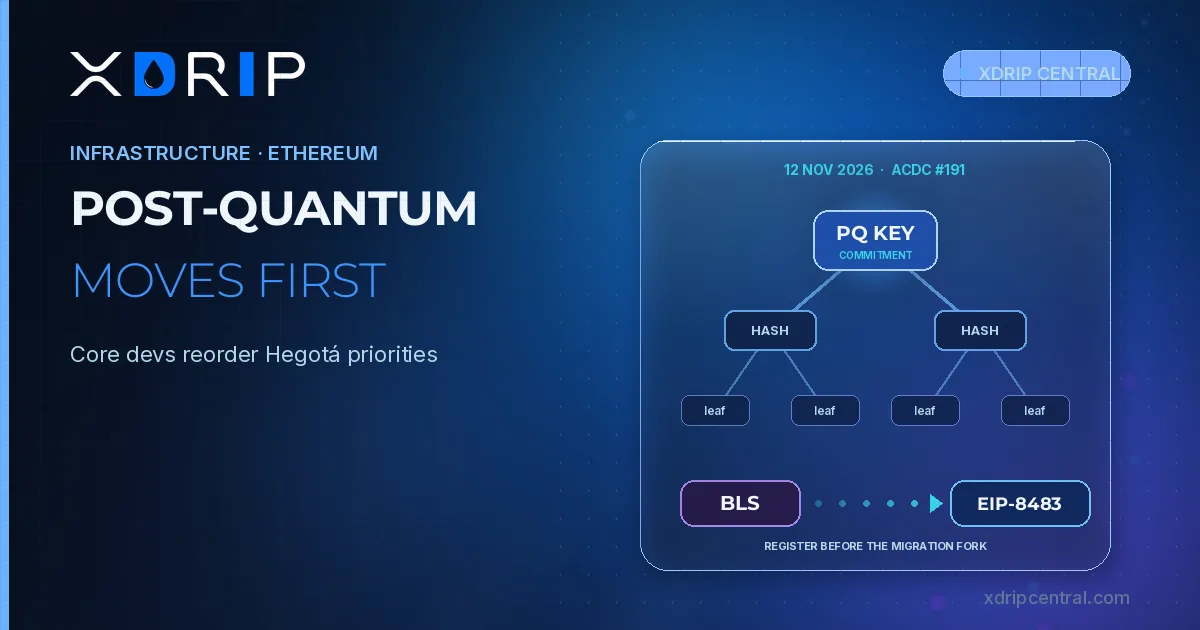
At ACDC #191 Ethereum devs withdrew Quick Slots and moved EIP-8483 post-quantum key registration toward Hegotá. What it does and what is still undecided.
In the early hours of Saturday, 14 November 2026, an attacker emptied the KAVA pool of Kava Lend, the native lending protocol of the Kava chain. Independent on-chain reviews by The Block and Bitquery put the amount borrowed at about 55.2 million KAVA, roughly $3.76 million at the pre-attack price. No new tokens were created and no key was stolen. The entry point was a market almost nobody used any more: BUSD, the stablecoin Paxos stopped minting in 2023.
According to Bitquery's reconstruction, the BUSD pool was close to dead before the attack. It owed lenders about 440,000 BUSD, had about 5,000 BUSD out on loan and almost no cash, while reserves on the books were larger than cash and loans combined.
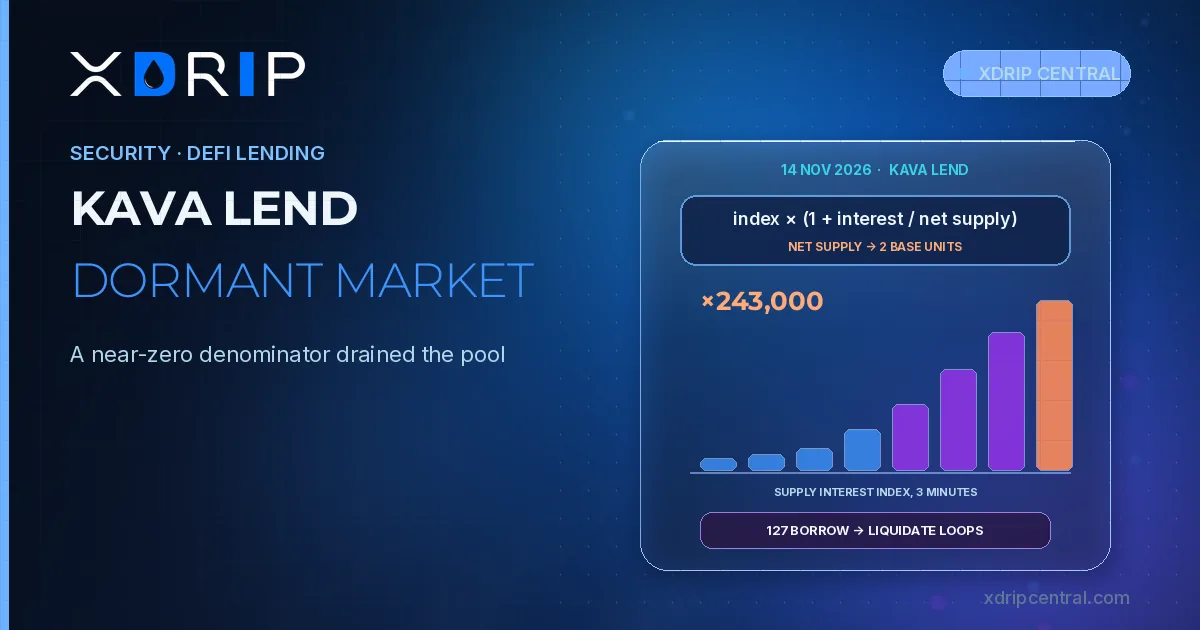
Shortly after 04:00 UTC, one wallet repaid every open BUSD loan in the pool, then deposited, borrowed and withdrew amounts chosen so that the pool's net supply came to two base units, the smallest amount of BUSD the chain can count. Over the next three minutes, the market's supply interest index rose about 243,000-fold. A deposit of a few thousand BUSD now read as roughly 1.26 billion BUSD of collateral.
A second wallet then borrowed KAVA against BUSD collateral that existed on paper only. In the following block the first wallet liquidated it; with the pool empty, the liquidation auctioned zero to two base units of BUSD and closed the debt. That cycle cleared the KAVA borrow cap and ran 127 times between 04:04 and 05:42 UTC. The KAVA pool fell from about 55.3 million coins to 519 by Bitquery's count; The Block later measured 0.19 KAVA.
About 49.2 million KAVA was bridged to BNB Chain through Kava's LayerZero bridge and sold for about 3,006.5 BNB and 231,557 USDT, about $2.09 million at the time. Bitquery reports that the Relay bridge blocked a transfer of 612,416 USDT and that much of the rest reached Hyperliquid. A blocked transfer is not a recovery, and nobody has said those funds will return to depositors.
Kava Lend's published code, in x/hard/keeper/interest.go, computes the supply interest factor as new interest divided by net supply (cash plus borrows minus reserves), plus one. The only guard is for a net supply of exactly zero. A tiny positive value, or a negative one, still goes through the division. In a healthy market the denominator is large and each accrual adds a small, bounded increment. In a dormant market with stale reserves, the denominator can be pushed next to zero, and every block multiplies every deposit.
The liquidation path then completed the loss. A liquidation that finds no collateral to seize should not be able to close a debt as if it had been repaid. That is the second failure the independent reviews describe, and it is the one that turned a broken index into repeatable borrowing.
Kava's first public acknowledgment came at 11:28 UTC, more than seven hours after the attack began. The team then said the event "is not an infinite mint" and is "isolated and contained within Kava Lend", paused Axelar bridge withdrawals (the funds had left through LayerZero), and said partner exchanges had paused KAVA deposits and withdrawals. It promised a complete incident report.
Known: the published interest code, the on-chain sequence, the bridge route and the blocked USDT transfer. Not known: an official loss figure, whether the liquidation logic has been patched, whether Kava Lend has been paused, how suppliers will be made whole, and who controls the wallets. Reported amounts differ slightly between sources; DefiLlama records about 53.9 million KAVA, which matches Bitquery's figure for what the attackers kept.
Our reading is that this was not exotic. Idle markets keep their code paths live long after their users leave, and accounting that is safe at scale can fail at the edges. For lending protocols, the practical points are narrow: guard interest and exchange-rate calculations against near-zero and negative denominators, cap how far an index can move in one accrual, refuse to close a liquidation that seized nothing, and deprecate or freeze markets whose asset is no longer issued. For users, a deposit in one market is exposed to every other market in the same pool.
NewsNov 13, 20264 min
At ACDC #191 Ethereum devs withdrew Quick Slots and moved EIP-8483 post-quantum key registration toward Hegotá. What it does and what is still undecided.
NewsNov 12, 20264 min
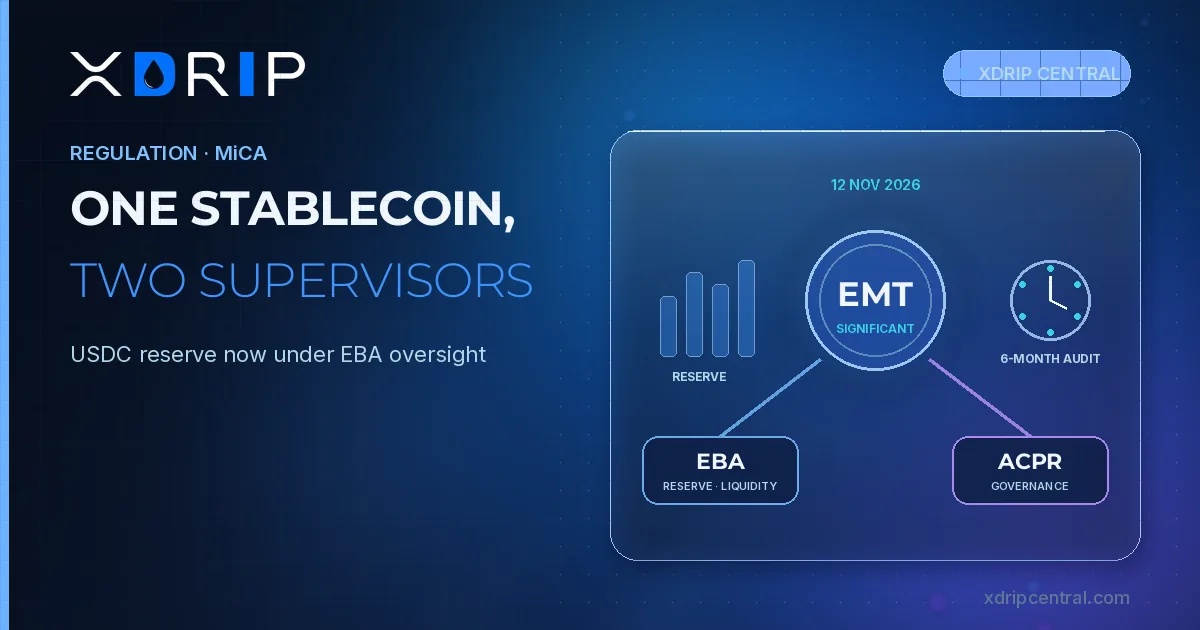
From 12 November the EBA directly supervises USDC's reserve, own funds and liquidity under MiCA. What changes, what stays with France's ACPR, what is unknown.
NewsNov 4, 20265 min
Signing and finality lessons on Central, backup guidance on xdrip.io, open firmware on Xdripia Waves and two new Seventh Amulet Dev Logs.