
Sicherheit20. Nov. 20265 min
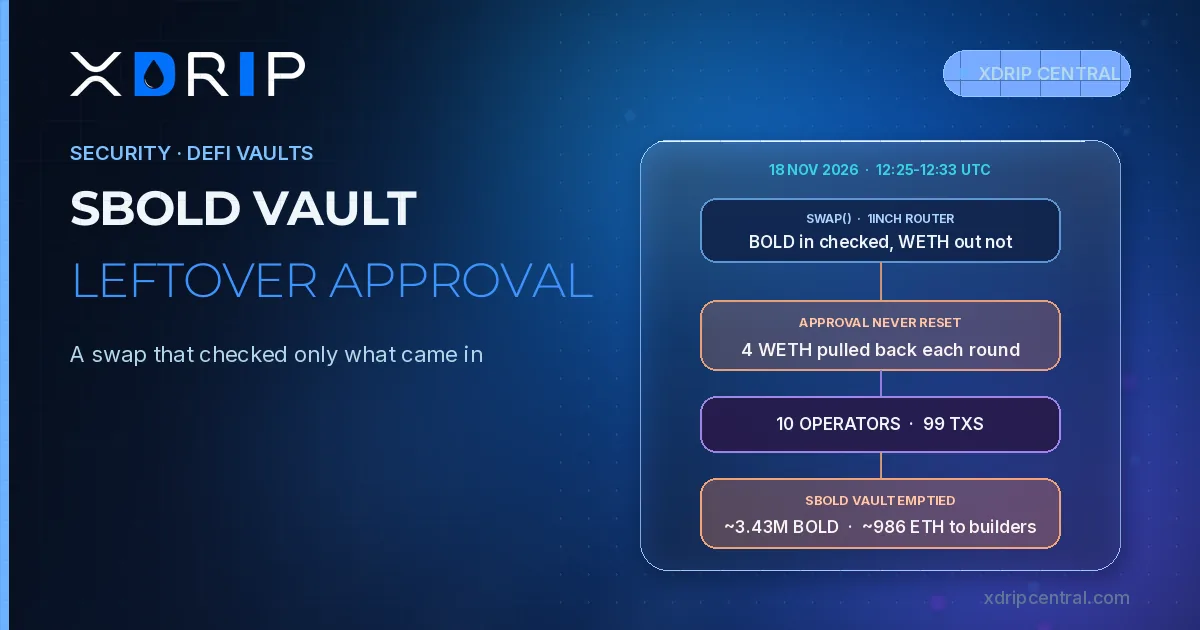
sBOLD Vault Drained Through a Leftover Swap Approval
K3 Capital's sBOLD vault lost about 3.43M BOLD after a swap check ignored the collateral side and left an approval open. What we know and what is unclear.
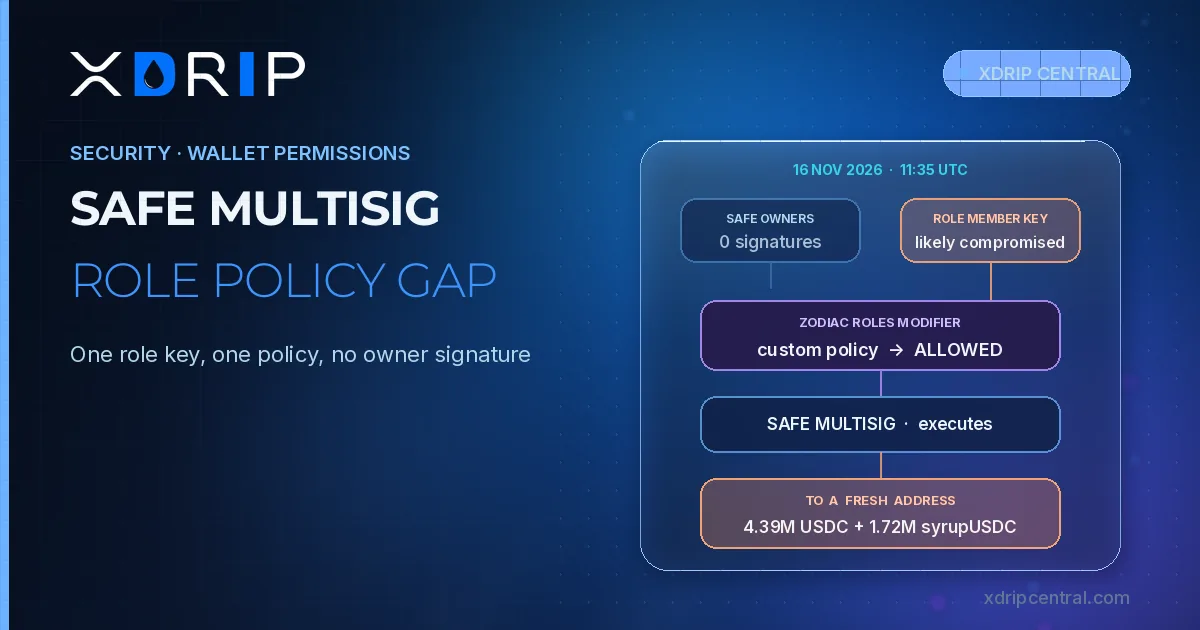
On Monday, 16 November 2026, a single transaction moved about 4.39 million USDC and 1.72 million syrupUSDC out of a Safe multisig on Ethereum, a loss of roughly $6.45 million according to PeckShield, which relayed the finding of on-chain investigator Specter. No owner of the Safe signed it. The transaction came in through a Zodiac Roles Modifier, a third-party module that lets a Safe delegate limited powers to other addresses, and it was sent by a role member key that Zodiac describes as most likely compromised.
Blockscout records the transaction 0x6c7cce68b6373dd0e645e6667d46788f49da5a4afc286bc363a2bf34f0a8c9c5 at 11:35 UTC. In one step it redeemed the Safe's position in a Gauntlet USDC vault on Morpho for 4,387,188 USDC, then sent that USDC together with 1,717,919 syrupUSDC, Maple Finance's yield-bearing USDC token, from the Safe 0x595362a906a0b4e90aee1430b1f80fdde2be80de to the fresh address 0x2b02c38022fee2f3c805055f49cd8d24a90cb9e1.
Part of the proceeds then moved to Hyperliquid. PeckShield counted about $813,000 spent on XMR1, a Hyperliquid-traded token named after Monero; Bitquery tallied about $1 million across five Hyperliquid accounts.
Safe said that one multisig was affected, that its smart contracts and the Safe{Wallet} app were not, that the module had been installed outside Safe{Wallet}, and that no owner signed the transaction.
Zodiac said it found no vulnerability in its contracts. Its co-founder Johannes Moormann told Cointelegraph that the module checked the transaction against the wallet's configured policy and allowed it, that the transaction came from the key of a long-standing role member, and that the custom policy permitted it, almost certainly unintentionally. The keys and the policy belonged to the wallet's operators; Zodiac says it had no access to them and no involvement in the setup.
A Safe normally executes a transaction only when a threshold of owners signs it. Modules are the exception by design: an enabled module can ask the Safe to execute transactions directly, with no owner signatures. The Roles Modifier uses this to let owners hand narrow, pre-approved actions to role members, for example rebalancing a vault position, without collecting signatures each time.
That makes the policy the real security boundary. If a role can redeem a vault position and can also transfer the resulting tokens to an address the policy does not pin down, then a single role key holds a path out of the multisig, and the threshold of owner signatures no longer protects those funds. On this reading, the attacker did not need to defeat the multisig; they needed one key and a permission that was broader than intended.
Known: the transaction, the amounts, the module it passed through, the statements from Safe and Zodiac, and the route of part of the funds to Hyperliquid. Not known: who operates the Safe, how the role member key was compromised, and exactly which policy condition allowed the transfer. Bitquery noted that the Hyperliquid route resembles the one used after the Lighter API key leak the same day, which we covered in our Lighter analysis, but found no on-chain transfer linking the two and attributes the wallets to no one.
As Unchained noted, this is also distinct from June 2026, when a bug in Zodiac's Delay and Roles modules was used to take about $1.5 million from Gnosis Pay users' wallets. Here, by both teams' accounts, the code behaved as written.
Our reading is that the weak point was configuration and key custody, not cryptography or contract code. For teams that run a Safe with modules, the practical points are narrow: treat every module and every role member key as equivalent to owner signing power when deciding where keys live; scope policies to explicit recipients and amounts, not only to functions; remove stale role members; and review enabled modules on a schedule, the same way owners and thresholds are reviewed. A multisig is only as strong as its weakest path to execution, and modules are paths.
Sicherheit20. Nov. 20265 min
K3 Capital's sBOLD vault lost about 3.43M BOLD after a swap check ignored the collateral side and left an approval open. What we know and what is unclear.
Sicherheit19. Nov. 20265 min
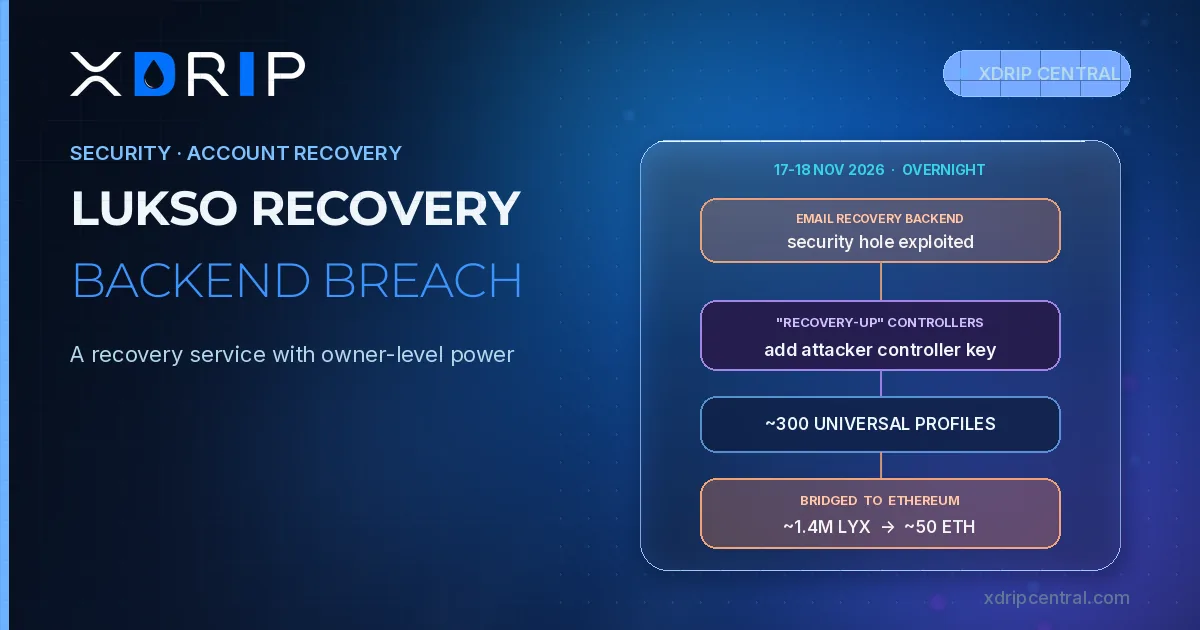
An attacker abused LUKSO's email recovery backend to add a controller key to about 300 Universal Profiles and take 1.4M LYX. What we know so far.
Sicherheit17. Nov. 20265 min
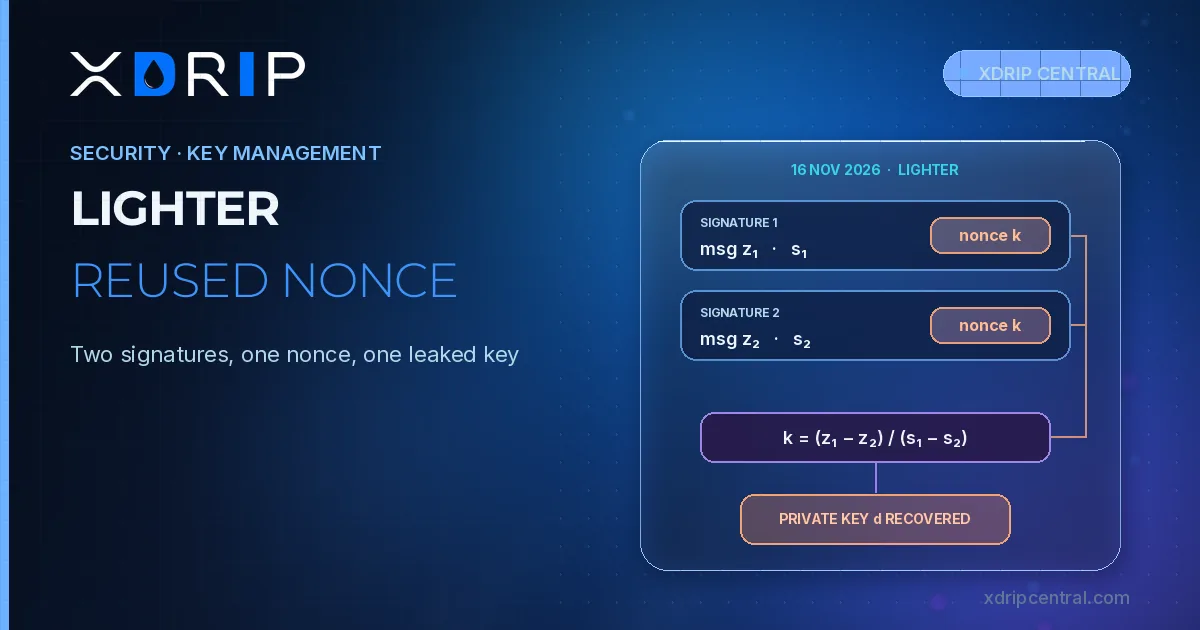
About 10.39M USDC left Lighter after a trader's signing code reused nonces, exposing an API key. How the key leaked, how funds moved and what changed.