
Sicherheit20. Nov. 20265 min
sBOLD Vault Drained Through a Leftover Swap Approval
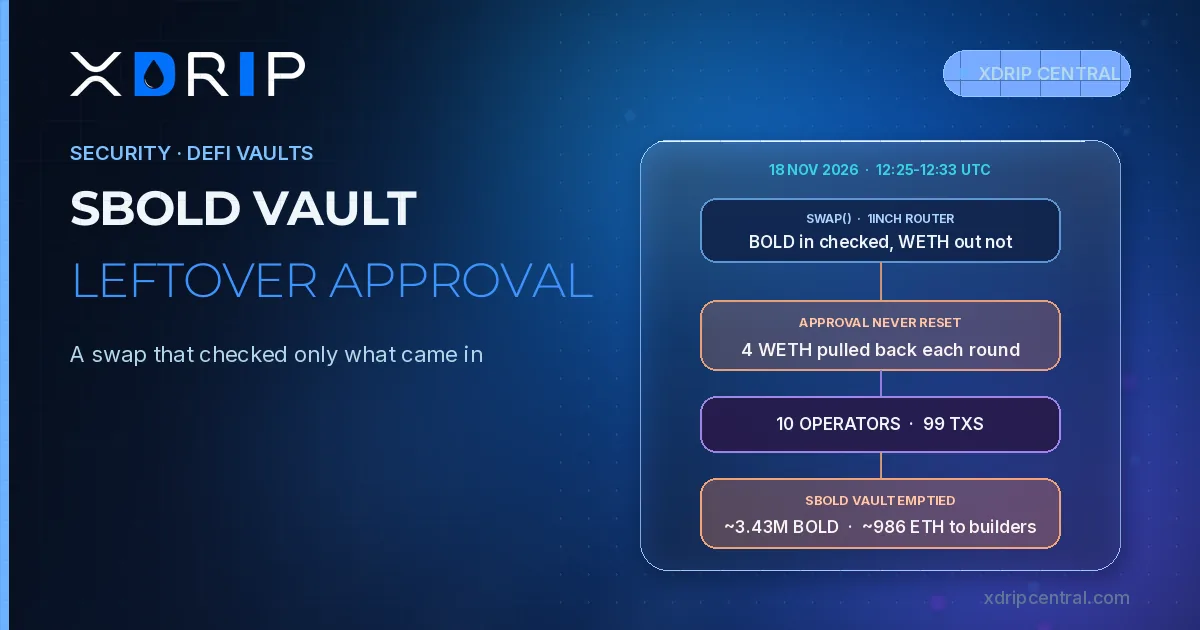
K3 Capital's sBOLD vault lost about 3.43M BOLD after a swap check ignored the collateral side and left an approval open. What we know and what is unclear.
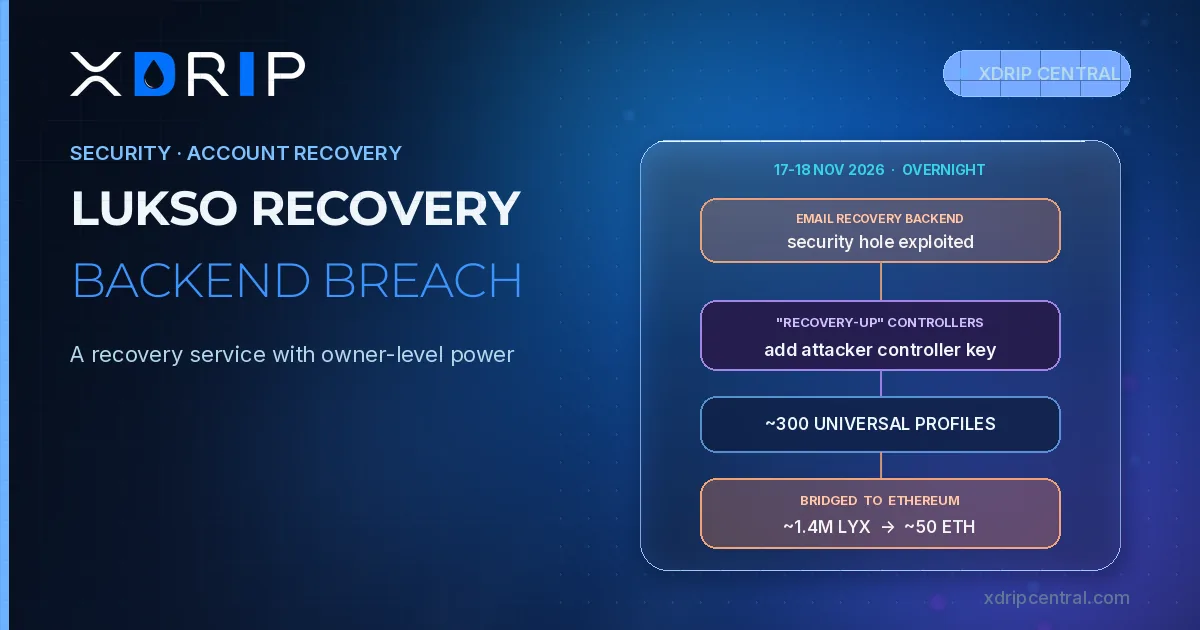
Overnight from 17 to 18 November 2026, an attacker took around 1.4 million LYX from about 300 Universal Profiles on LUKSO. They did not break the profiles' smart contracts or steal anyone's recovery phrase. According to LUKSO's own post-mortem, they found a security hole in the backend of the project's email-based recovery service and used it to take over the service's own "recovery" profiles, which were already installed as controllers on users' accounts.
A Universal Profile is a smart contract account. It is controlled by one or more controllers, keys or other contracts, and each controller holds only the permissions the owner grants it. Users who opted into email-based recovery had a "recovery-UP" controller on their profile, so that the service could help them regain access if they lost their device.
LUKSO says the attacker gained control of those recovery profiles and used them to add a new controller key, 0xa2f8Fd85366d1B4A3B13C33A48CD959F6D1Ba3a7, to about 300 profiles. That key then moved assets out. LUKSO posted an urgent alert on X at 07:26 UTC on 18 November and published the post-mortem later the same day.
LUKSO says the attacker bridged the full amount to Ethereum and swapped it on decentralized exchanges, including Uniswap, for about 50 ETH, roughly $95,000. The proceeds sit at 0x4d2BFb7Ca38Cb3Ea136845a9dd0FBEACe2Cd365C; when we checked the address on Blockscout on 19 November it held 52.4225 ETH, matching the figure The Defiant reported from Etherscan.
The Defiant also counted about 1.5 million bridged LYX arriving at a collection address on Ethereum across ten transfers, a measure of what crossed the bridge rather than a per-profile loss tally. It noted that 1.4 million LYX would be worth about $330,000 at the day's market price, well above the sale proceeds, because the tokens were sold quickly into limited liquidity.
LUKSO states that the LUKSO blockchain and the Universal Profile contracts were never affected and worked as designed, that no private keys or recovery phrases leaked, and that profiles that did not use email recovery were never at risk. File-based and device-keychain backups, it says, remain secure. The email recovery service has been switched off and is being decommissioned, so no new profiles can be added to the incident. LUKSO says it is working on a way to reimburse affected users and will share details in the coming weeks.
Known: the approximate number of profiles, the approximate amount, the attacker key, the destination address, and the remediation steps. Not known: what the backend flaw was, how the attacker found it, exactly when the attack began, how many profiles actually lost funds and how much each lost, and the terms or timing of any reimbursement. LUKSO's figures are approximate, and its guidance on the recovery controller changed between the first alert and the post-mortem: the alert said to remove both controllers completely, the post-mortem allows removing the recovery controller or revoking its "Add Permission" permission.
One point matters for anyone affected: until the attacker's key is removed, it can still move whatever is left on a profile. LUKSO warns that the key may not appear in the controller list and should be removed anyway, using its UP Authorize app, and it provides an incident checker at incident-check.lukso.tools.
Our reading is that this is a custody incident, not a smart contract failure. A recovery service that can add controllers to an account holds owner-level power over that account, whatever its user interface says. When that service runs on a centralized backend, the backend becomes part of the account's security boundary, and one flaw there reaches every account that opted in. We saw a similar pattern earlier this month with the Web3Auth flaw that exposed Keplr social-login keys: convenience layers around self-custody can carry more risk than the keys they protect.
The design also showed its upside. Because Universal Profile keys are separate from the account, owners can remove the attacker's key and keep their profile, its name, history and remaining assets, which a single-key wallet would not allow. For teams building account recovery, the practical points are narrow: give recovery controllers the least permission they need, avoid standing "add permission" rights where a time delay or owner confirmation can be used, make every controller visible to the user, and treat the recovery backend with the same care as a signing key.
Sicherheit20. Nov. 20265 min
K3 Capital's sBOLD vault lost about 3.43M BOLD after a swap check ignored the collateral side and left an approval open. What we know and what is unclear.
Sicherheit18. Nov. 20264 min
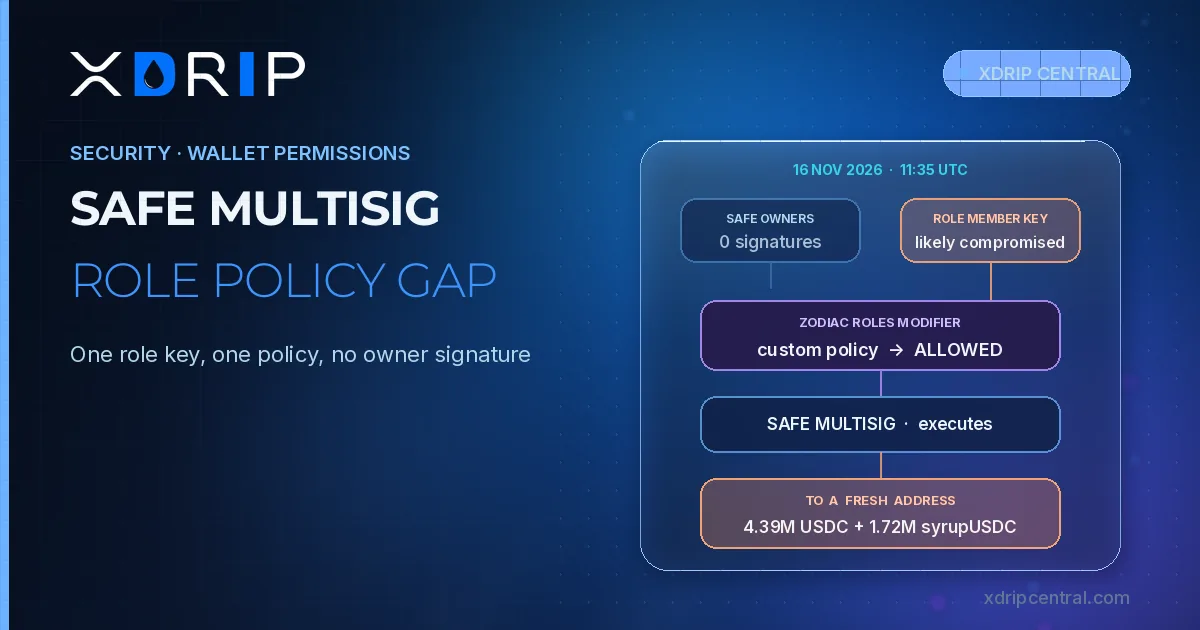
A likely compromised role key moved 4.39M USDC and 1.72M syrupUSDC out of a Safe multisig via a Zodiac Roles policy, with no owner signature. What we know.
Sicherheit17. Nov. 20265 min
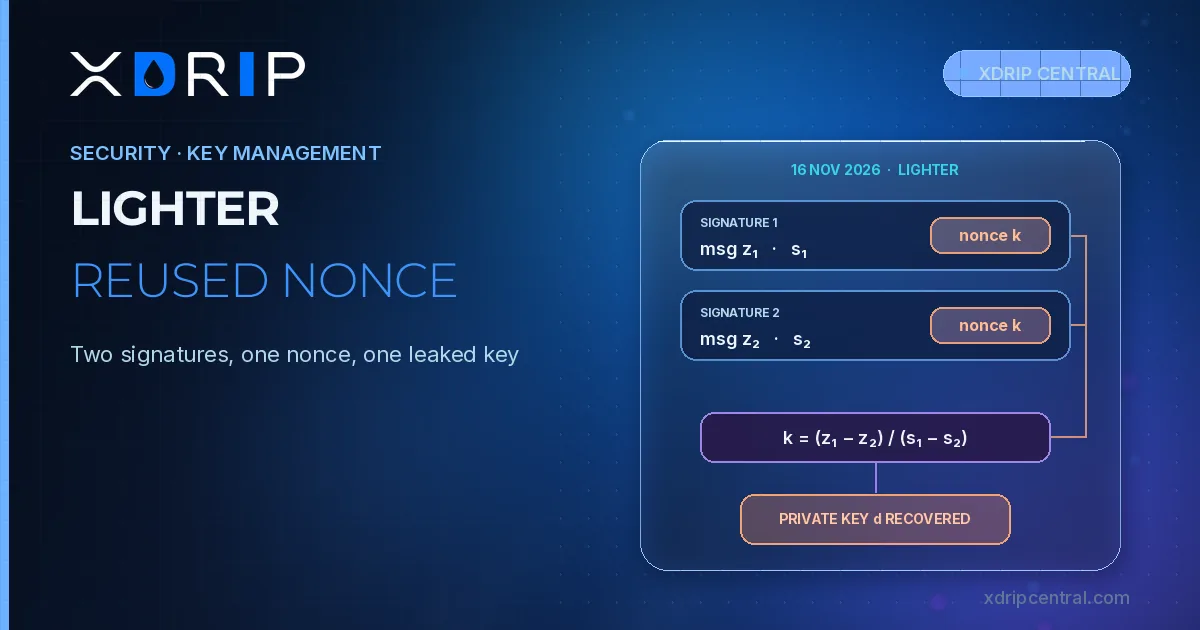
About 10.39M USDC left Lighter after a trader's signing code reused nonces, exposing an API key. How the key leaked, how funds moved and what changed.