
Sicurezza19 nov 20265 min
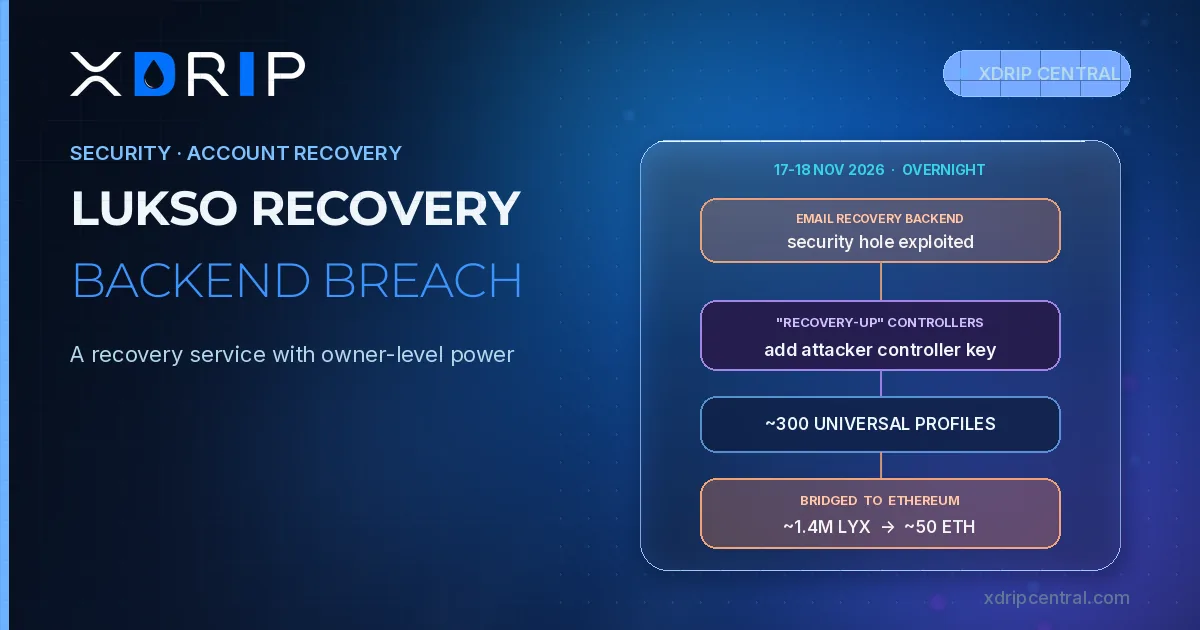
LUKSO Email Recovery Breach Hits 300 Profiles
An attacker abused LUKSO's email recovery backend to add a controller key to about 300 Universal Profiles and take 1.4M LYX. What we know so far.
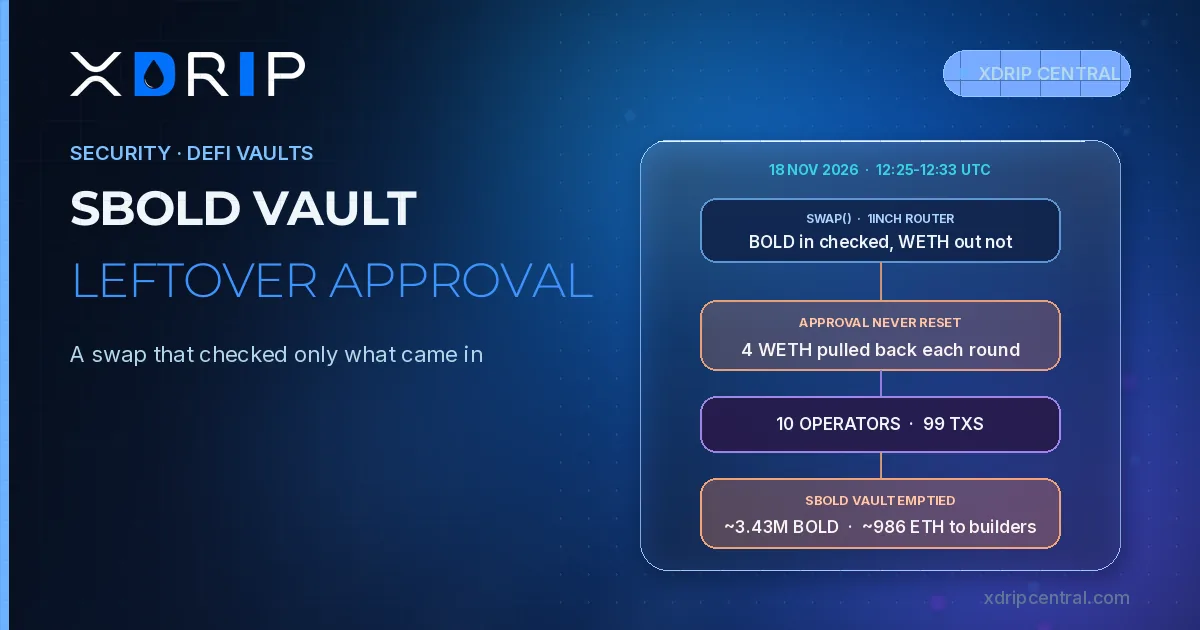
On 18 November 2026, between 12:25 and 12:33 UTC, attackers emptied K3 Capital's sBOLD vault on Ethereum of about 3.43 million BOLD, close to everything it held. K3 Capital published a postmortem on 19 November, prepared with ChainSecurity. Its conclusion: the loss came from a token approval left in place after a swap that never took the collateral. Liquity V2, the protocol whose stablecoin the vault holds, and the 1inch router were not exploited.
sBOLD is an ERC-4626 savings vault run by K3 Capital. Users deposit BOLD, Liquity V2's dollar stablecoin, and the vault places it in Liquity's Stability Pools. Its share price counts both the BOLD it holds and any collateral it has received, and a public swap() function lets anyone convert that collateral into BOLD through the 1inch router, using calldata the caller writes.
According to the postmortem, swap() approved the router to spend the collateral and then checked only that enough BOLD arrived. It did not check that the collateral left the vault, and it did not reset the approval afterwards. Each attack round followed the same pattern: borrow BOLD and deposit it to hold most of the vault's shares, send 4 WETH to the vault, call swap() with calldata that delivered BOLD without moving the WETH, redeem shares at a price that now counted both, then use the leftover approval in a second swap to take the 4 WETH back. Each round yielded at most about 7,460 BOLD, so the drain took 99 transactions by K3 Capital's count (Bitquery counts 97 drain transactions).
Once the first attack transaction landed, other operators copied it. K3 Capital counts ten operators, including a generalized MEV bot, and says the vault lost 99.9% of its assets within about 7.5 minutes. Bitquery's on-chain analysis found the copycat bot pulled out about $1.91 million, 56% of the loss, and paid most of it to block builders for priority. Builders received about 986 ETH, roughly $1.78 million, which K3 Capital says was passed on to 21 validator fee recipients. CoinDesk notes these are payments received, not confirmed profits. The wallet that first deployed the exploit and a second wallet it funded took about $0.52 million, which Bitquery traced to THORChain and Maya Protocol.
The vault was paused at 13:05 UTC through its owner multisig, about 30 minutes after it was empty. When we queried the vault contract on 20 November it reported itself paused, with total assets of about 4.5 BOLD.
Known: the mechanism, timing, approximate loss, main recipients and the pause. K3 Capital also says it has identified holdings worth about 1.7 million BOLD at the attack-time ETH price, is in contact with the counterparties, and offers a 15% bounty for funds returned to a single designated address. Yearn said it would forward about 131,000 BOLD of attacker loan fees that reached its vaults. Not known: how much will actually be returned, what depositors will finally receive (K3 Capital says repayment depends on recoveries and the ETH price at conversion), and the losses of Pendle users, whose SY-sBOLD wrapper held about 12.8% of the shares. The first public alerts blamed self-liquidated Liquity loans; the postmortem and Bitquery both say no liquidations were involved.
Our reading: this was not exotic. A swap check that only looks at what came in is a price check, not a settlement check. With caller-written router calldata, the caller decides whether the input moves at all, and an approval that outlives the call is a standing withdrawal right for whoever makes the next call. SigIntZero notes the audited High finding on share pricing was fixed in the deployed code; this was a different path.
It also shows how fast a public exploit becomes everyone's: copycat bots took most of the value within minutes, and a pause needing multisig signatures came after the vault was empty. For vault builders the practical points are concrete: verify both sides of every swap, reset allowances after any external call, do not let anonymous callers write router calldata, and give a narrowly scoped guardian the ability to pause in the next block.
Sicurezza19 nov 20265 min
An attacker abused LUKSO's email recovery backend to add a controller key to about 300 Universal Profiles and take 1.4M LYX. What we know so far.
Sicurezza18 nov 20264 min
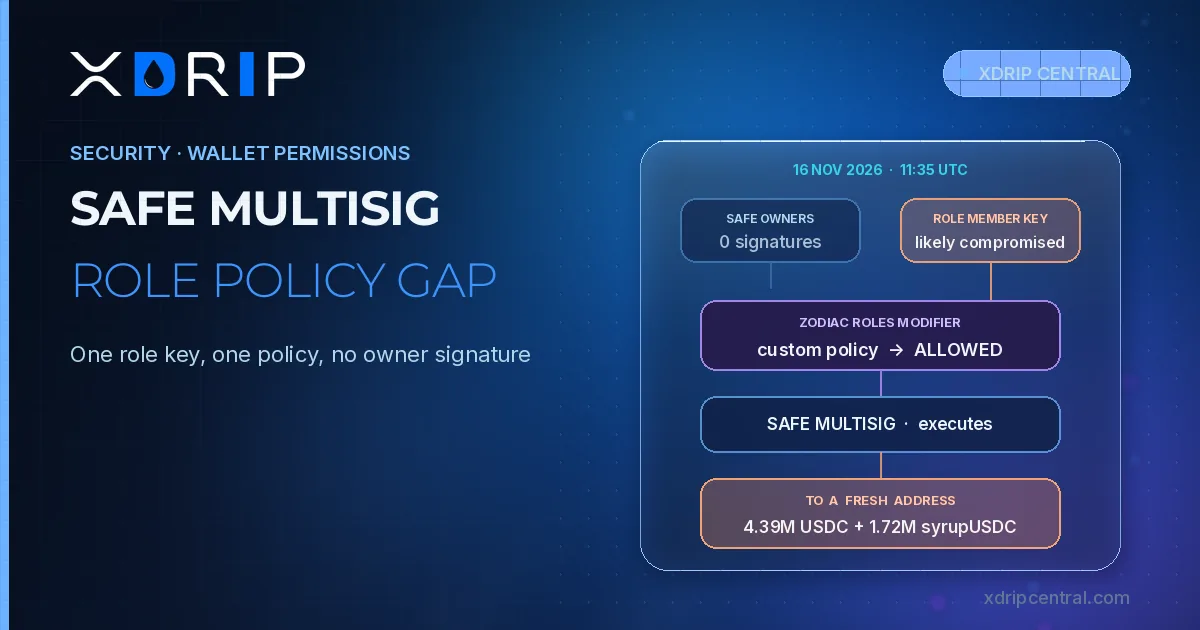
A likely compromised role key moved 4.39M USDC and 1.72M syrupUSDC out of a Safe multisig via a Zodiac Roles policy, with no owner signature. What we know.
Sicurezza17 nov 20265 min
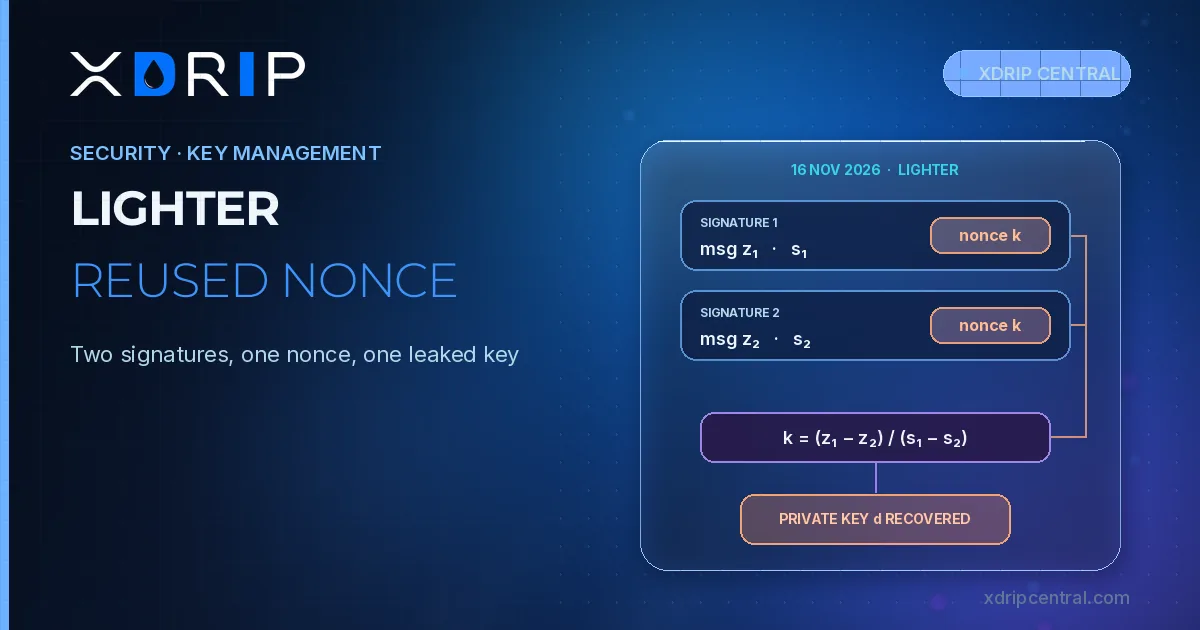
About 10.39M USDC left Lighter after a trader's signing code reused nonces, exposing an API key. How the key leaked, how funds moved and what changed.